Meara's Making Mischief

A time travel through fabric, food and (herbal) formulations

  • Of Timelines, Cabbages and Kings

    So, it’s been a minute since there’s been a new blog post, and a lot has happened in that time. I sold my house and moved back to Mass, which I said I’d never do again, and yet here we are. I had major surgery that I am 100% — okay, maybe more like 95% — recovered from, and with that, all systems are go. I repeat: all systems are a go.

    So what does that mean? It means it’s time to deep dive back into research. It’s time to start crafting and creating and making things, to reconnect with the crafts that I love, and to learn new skills. With this also comes a change in theme, a clarification of paths, and an update on all things SCA, so let’s dive in.

    When I started with the SCA, I started with an early-period Hiberno-Norse persona. For a newish sewer, triangles, squares, and rectangles are easy, even if a keyhole neckline is an absolute bugger. I made a few preliminary outfits based on some fast-and-loose internet searches and leaned heavily into what I affectionately call “close enough for Norse-ish.” There is 100% nothing wrong with that. It worked for me back then, and I encourage people to use that approach if it works for them now. After that, I dabbled in some later-period garb and persona ideas, then wound up back in the 10th-century Hiberno-Norse zone for a number of reasons.

    Information on late Iron Age and early medieval Irish clothing is pretty thin on the ground. Part of the problem is preservation. Irish bogs are very acidic, and while those acidic, anaerobic conditions can preserve some organic materials remarkably well, preservation is uneven. Animal-based materials such as skin, hair, and wool may survive in ways that plant-based textiles like linen often do not, which complicates any attempt to reconstruct a full clothing system from surviving finds.

    Mortuary evidence is also tricky. Cremation continued in parts of first-millennium Ireland alongside inhumation, which means clothing evidence from graves is not as straightforward or abundant as it is in some other regions.

    There also appears to have been a population decline during the Iron Age and early medieval period in Ireland, for reasons that are still not well understood. Archaeologists are continuing to study this question, but it adds another layer of complication when looking at settlement patterns, material culture, and the survival of evidence.

    There is some information in early Irish legal material about clothing, color, value, and status. Fergus Kelly’s Early Irish Farming discusses the price and importance of sheep fleeces in early Ireland, including distinctions between fleece colors. From that, we can cautiously think about wool, wool cloth, dyeing, and textile value. White fleeces, for example, may have been more valuable than tan or black fleeces in part because they were easier to dye. (Kelly, Early Irish Farming, 67–77)

    Both flax and linen are also mentioned in Cáin Lánamna, indicating that linen was known and used in early medieval Ireland, though that still does not tell us exactly how garments were cut or constructed. (Kelly, Early Irish Farming, 269)

    So while we know that wool and linen were part of the clothing world, and while literary evidence gives us some idea of garment categories — brats or mantles as outer layers, and léinte as inner or underlayers — what we are often missing is the practical construction evidence. What did these garments look like? How were they shaped? How were they sewn? How much did they vary by region, status, gender, and period?
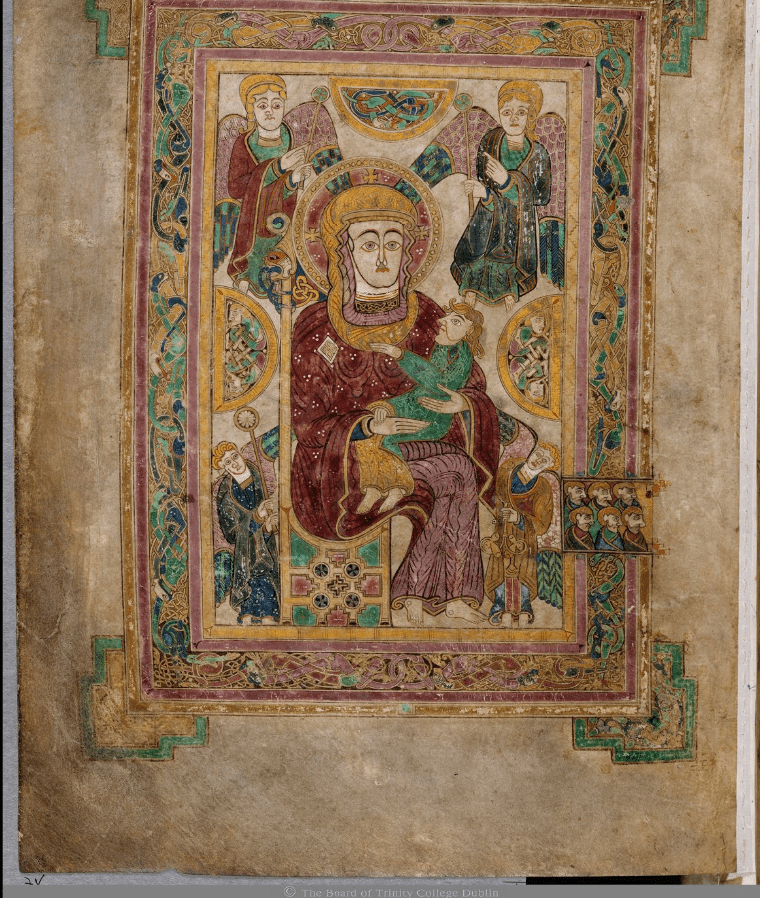
    (Image from Book of Kells. Folio 7v: Virgin and Child)

    Another issue is that this is just about the only female figure we have from this period for Ireland that is not a carving. The fastening shown at the chest has often reminded modern viewers of early medieval Irish brooch forms, and I’d like to compare it more carefully with National Museum of Ireland examples once I can access the relevant object records. At the time of writing, the National Museum of Ireland website is having technical difficulties, so that image is currently unavailable.
    The red outer layer appears to be a brat, though it is missing the fringe usually associated with the garment. That could be an artistic choice, or they could be like me: fringe gives me a textural ick.

    So why Hiberno-Norse? Why come back to this particular time, place, and cultural tangle?

    Part of it is practical. I already had one foot in this world when I started in the SCA, even if that first version was held together with enthusiasm, rectangles, and vibes. But the more I come back to it, the more I realize that 10th-century Hiberno-Norse Dublin sits right at the intersection of so many things I care about: textiles, trade, identity, migration, craft, adaptation, and the messy reality of people living in contact with one another.

    And part of it is personal.

    This is where my family is from. This is where my history starts, or at least one of the places where it starts. Digging into this time and place is not just an abstract research exercise for me. It is a way of reaching backward, of trying to understand something about the people, places, skills, and survival that came before me.

    There is also something deeply grounding about doing the kinds of work that women have done for generations: spinning, sewing, cooking, mending, making, tending, planning, preserving, feeding, clothing, and creating. These are not small things. They are the work of keeping people alive. They are the work of household, community, memory, and care. When I pick up fiber, cut cloth, test a stitch, cook from older foodways, or try to understand how a garment may have been made, I am not only learning a craft. I am placing my hands inside a much longer chain of women and family who made, repaired, adapted, and carried on.

    That matters to me.

    It is not simply “Irish” and it is not simply “Viking.” It is a port town, a trading network, a meeting place, a contested space, and a community where material culture was doing a lot of work. Clothing, pins, beads, tools, textiles, leather, wood, and metalwork all become ways of asking bigger questions. What did people keep? What did they adopt? What did they adapt? What did they make locally? What did they import? How did they signal who they were, or who they wanted to be seen as?

    That is the part that keeps pulling me back.

    This project is going to start with clothing, because clothing is where my hands want to begin. I want to build a practical, wearable, research-based wardrobe that can shift between an Irish-compatible base and a more specifically Dublin/Norse-Gael expression depending on the accessories, textile choices, and documentation. The goal is not to make a generic Viking outfit and slap an Irish brooch on it. The goal is to start from Dublin and Ireland first, then carefully use comparative evidence from places like York, the Isle of Man, Orkney, the Hebrides, and Scandinavia only when the local evidence goes quiet.

    That means some things will be straightforward. Wool and linen? Yes. Brats, léinte, pins, headcoverings, leather shoes, knives, combs, pouches, and practical layers? Very likely, with varying degrees of evidence depending on the item. Other things will need to be handled more carefully. Complete garment shapes, nålbound socks or mittens, bright colors, imported textiles, and anything too heavily borrowed from elsewhere will need documentation, caveats, and probably experimental testing.

    And that is where this gets exciting.

    This is not just going to be a garb project. It is going to be a research project, a making project, and probably a long conversation with myself about evidence, interpretation, and how much uncertainty I can tolerate before I start muttering at footnotes. I want to read the excavation reports. I want to look at the textile fragments. I want to understand the pins and the headcoverings and the leather finds. I want to test yarns, stitches, seams, dyes, recipes, and construction methods. I want to make things, use them, wear them, feed people with them, revise them, and then make better things.

    The working rule for this project is going to be: Dublin first, Ireland second, the Irish Sea third, and the wider Viking world only after that.

    Or, put more bluntly: not generic Viking with an Irish pin slapped on it.

    So that is where this is going. Back to the 10th century. Back to Dublin. Back to wool and linen and brooches and brats. Back to cooking, stitching, making, researching, experimenting, mistakes, revisions, and the very particular joy of realizing that one “simple” question has somehow become a reading list, a fabric order, three craft experiments, and possibly a long-term academic problem.

    All systems are go.
  • Imbolc

    or OOOOHHH we’re half way there…OOOOHHHH!!!! The goddess has red hair (Yes..this blog is going to be like this. Probably all the time. You’ve been warned)*

    Imbolc or Imbolg, Candlemas or St. Brigit’s day marks the halfway point between Yule/Midwinter and the Spring Equinox. We have made it through the darkest six weeks of winter, and our now on our way to Spring. The days are getting longer, (It’s no longer dark at 5pm WOOHOOO!), the birds are singing their Hey baby come here often? song at the bird feeder, and even the squirrels are in a better humor. It’s a time when, in more temperate climates (aka Ireland and Scotland and not Maine) the first lambs and calves drop, and with it the first milk of the year.

    Traditionally celebrated on 01 February..let’s stop here for a moment. Just like Samhain and Beltaine, the date was probably flexible, as it relies on two dates that are not fixed points in time- Mid Winter and the Spring Equinox. Both happen around the 20th/21st/22nd ish of the month that are are in in the Gregorian Calendar. Therefore the date of Imbolc also likely changed based on those two dates.

    Moving right along, most folks these days celebrate it on 01 February +/- a day or two. This year I’m celebrating it on the 3rd, as I got whatever plague is currently going around. I’m absolutely fine with this; this holiday celebrates Brigit, who amongst other things was a healer. I figured she would be ok with me taking a couple of days to get on the mend before celebrating.

    Brigit is a multi fascinated goddess- poetry, healing, black smithing, and wise woman. So important to the people of Ireland was she that she more than likely either tranformed from a pagan deity to a Christian Saint, or combined with an existing Abbess and their attributes were combined, either way there is still a huge number of folks her venerate her still today , from both sides of aisle. There are a number of holy wells and spring attributed to her in Ireland, many of which still have very active shrines that people make pilgrimages to in search of healing.

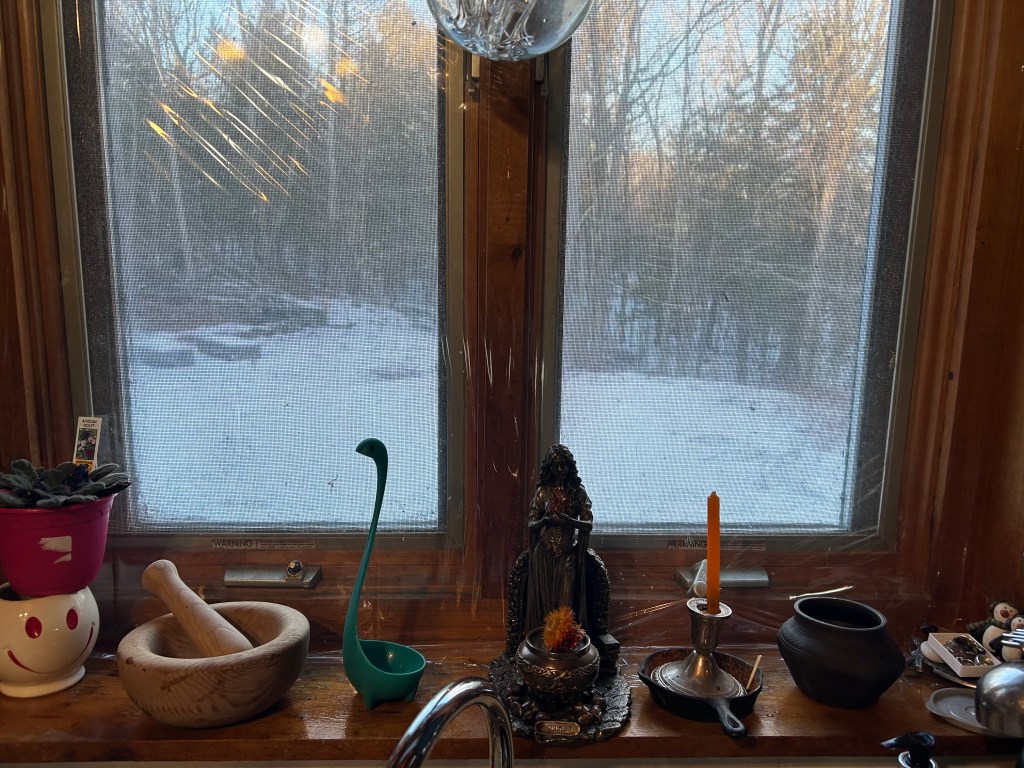
    My celebration this year, as it has for the last three years, looks very different from what it used to. As a solitary practitioner, my celebrations have been pared down, and have gone back to the basics. I have a statue of Brigit that sits on my kitchen windowsill that I light a candle at every morning as part of my daily ritual.

    I like to think of her as watching out and blessing my heart and home from the window above the kitchen sink, while I work my kitchen magic at the stove and counter.

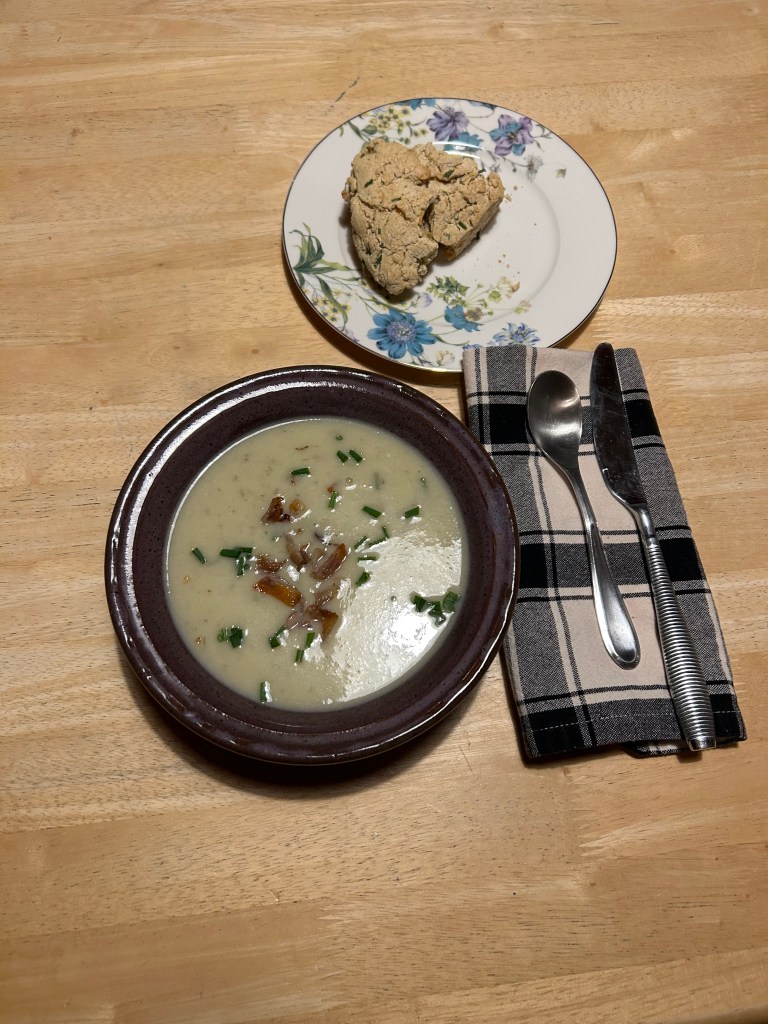
    And today, while I make Potato and Onion Soup with Soda Bread to go along side it ( you knew there’d be recipes here.) I will sit and contemplate what Brigit means to me, what my path means to me, and what transformations I hope to achieve in the coming Spring. It’s a time to write out some goals for the year, both SCA and personal, and see where these new seeds can take me.

    Potato and Onion/Leek Soup

    Ingredients:

    • 2 medium yellow onions, sliced
    • 2 to 2.5 lbs potatoes, peeled and chunked (russet suggested as they give soup a creamier texture)
    • 2 TBLSP (ish) of butter or ghee
    • 3 cups milk
    • 5.5 cups chicken stock
    • ½ t Celery Seeds
    • ¼ t Thyme
    • ¼ cup chives
    • salt and pepper, to taste
    • ½ cup (or more to taste) heavy cream
    • Roux
      • 2TBLSP Butter
      • 2TBLSP Flour (may substitute a gluten free flour mix)
    • For Serving
    • 6 Lardons / bacon strips (Or more..you do you.)
    • Chopped chives

    Instructions

    Sauté onions in butter over low heat until translucent. Once onions are translucent, add potatoes, milk, chicken stock, herbs, and chives.

    Simmer on low for 20-25 minutes or until potatoes are tender.

    Using either an immersion blender or regular blender, puree soup until creamy. Look out for the potatoes, because they are shifty and hide at the bottom.

    To make the roux, melt butter in a small saucepan. Once melted, add flour, stirring while it cooks for 1-2 minutes.

    Slowly stir roux into soup. Bring soup to a slow simmer for 1-2 minutes, then turn off heat.

    Add in cream and serve with garnishes and soda bread.

    Irish Soda Bread

    Ingredients

    • 6 cups all-purpose flour*
    • 2 Tsp baking soda
    • 2 Tsp baking powder
    • 3 TBLSP cornstarch
    • 2 Tsp sugar
    • l Tsp salt
    • 2 ½ cups buttermilk

    Instruction

    Preheat oven to 375°.

    Add all dry ingredients in a large bowl. Mix well. Pour buttermilk into bowl and stir, using a wooden spoon, until a soft dough is formed.

    Pour contents of bowl onto counter and knead for a minute or so until everything comes together.

    Divide dough into two portions. Shape each into a round loaf, pressing top down a bit to barely flatten.

    Place loaves on large ungreased baking sheet. Sprinkle each loaf with some additional flour. Using a sharp paring knife, cut an X on top of each.

    Allow loaves to rest for 10 minutes, then bake on middle rack for 40 minutes or until loaves are golden brown.

    *Can substitute gluten free flour, but will need to add additional buttermilk.

    A couple of notes:

    I have made both of these as dairy free/gluten free recipes and they work really well. This time I added fresh chives and dairy free cheddar cheese to the soda bread, and it was amazing.

    I use an immersion blender for this soup. No mater how many times I make it (And it’s been going on 20 years now), I always find a potato that I missed and didn’t blend. It will happen, go with it.

    The bacon in the soup this time was jowl bacon from a local farm. The form of bacon isn’t really important- turkey bacon works just as well. It’s just a nice texture contrast.

    This soup is way more filling then you think it’s going to be. Way more. It works well in half batch sizes. If you think you need to serve it with anything else, I would suggest a salad.

    Additional Resources:

    The amazing folks over at the Irish Pagan School have some wonderful resources not only on Imbolc and Brigit, but a number of other topics related to Native Irish spirituality. The founders are both natives of Ireland, and put an extraordinary amount of time and research into their teachings. They have a number of free classes available for those that would like to dip their toes in, as well as a number of deeper dives. They can be found on the web here https://irishpaganschool.com

    St. Brigid http://saintsresource.com/brigid-of-ireland https://en.wikipedia.org/wiki/Brigid_of_Kildare

    Today’s Spotify playlist https://open.spotify.com/playlist/37i9dQZF1E367HVEwusisE?si=a26337ae2b3f4edf

    *Really? You thought this was going to be different from how I am in real life? Please. ^.^

  • A 12th Night Feast

    On Saturday, 06 January the Malagentian Cook’s Guild held a 12th Night Garbed Pot Luck in collaboration with the Forest Court of Malagentia (More Information on both guilds can be found at the bottom of the post)

    Never one to let a opportunity slip by to either 1) dress up and 2) crack open one of my books on medieval food, I of course had to go! (It also helped that the event was less than 15 minutes from my house, so easy to get to, and easy to get home from with a winter storm on the horizon.

    I had originally been planning to make a salt cod dish, as would have been something that would have been seen on the table of Tudor period folks during this time, though not necessarily during the 12th Night period. But, salt cod being thin on the ground in my part of Maine, I went with plan 2, Chicken with Fennel.

    This recipe originally appears in Frammento di un libro di cucina del sec. XIV, edited by Olindo Guerrini. I am using the translation from The Medieval Kitchen- Recipes from France and Italy by Odile Redon, Francoise Sabban and Silvano Servennti, Translated by Edward Schneider.

      Fennel Chicken

      Take then chickens, cut them up, fry them, and when they are fried add the quantity of water you prefer; then take “beards” of fennel, “beards” of parsley, and almonds that have not been skinned; and chop these well, mix them with the liquid from the chicken, and boil everything, then pass through a sieve. Add it to the chicken, and add the best spices you can get – Guierrini 45

    Redacted Recipe:

    • 1 Free Range Chicken *
    • 2/3 cup (100g) unblanched almonds
    • a handful of dill or fennel leaves
    • a handfull of parsley
    • 2 cups (1/2 litter) water
    • scant 1/2 teaspoon fine spices **
    • 2 tablespoons lard or oil
    • salt

    Cut the chicken into serving pieces and pat dry. Melt the lard/heat the oil in a casserole over medium high heat and brown the chicken. When it is golden brown, add the water and salt to taste. Lower the heat and summer, covered, for 40-45 minutes or until tender.

    Meanwhile, wash and thoroughly dry the herbs. Grind the almonds finely in a blender, then add the herbs and blend to a paste.

    Remove the chicken from the casserole and keep it warm in a very low oven (~170F) covered loosely with aluminium foil.

    Add the almond mixture to the casserole and recude over medium heat until the sauce has thickened.

    Arrange the chicken on a serving platter and strain the sauce over the chicken. Sprinkle with the spices to taste and serve.

    Fine Spice Mixture

    Fine Spices for all foods. Take an onza of pepper and one of cinnamon and one of ginger and half a quarter of cloves and a quarter of Saffron (Libro di cucino del secolo XI, Ludovico Frati, editor)

    • 2 rounded tablespoons ( 16 g) freshly ground black pepper
    • 2 rounded tablespoons (16g) ground cinnamon
    • 2 rounded tablespoons (16 g) ground ginger
    • 1.5 tablespoonds (4 g) saffron threads, crushed to powder in a mortar or with your fingers
    • 3/4 teaspoon (2 g) ground cloves

    Add photos of each step

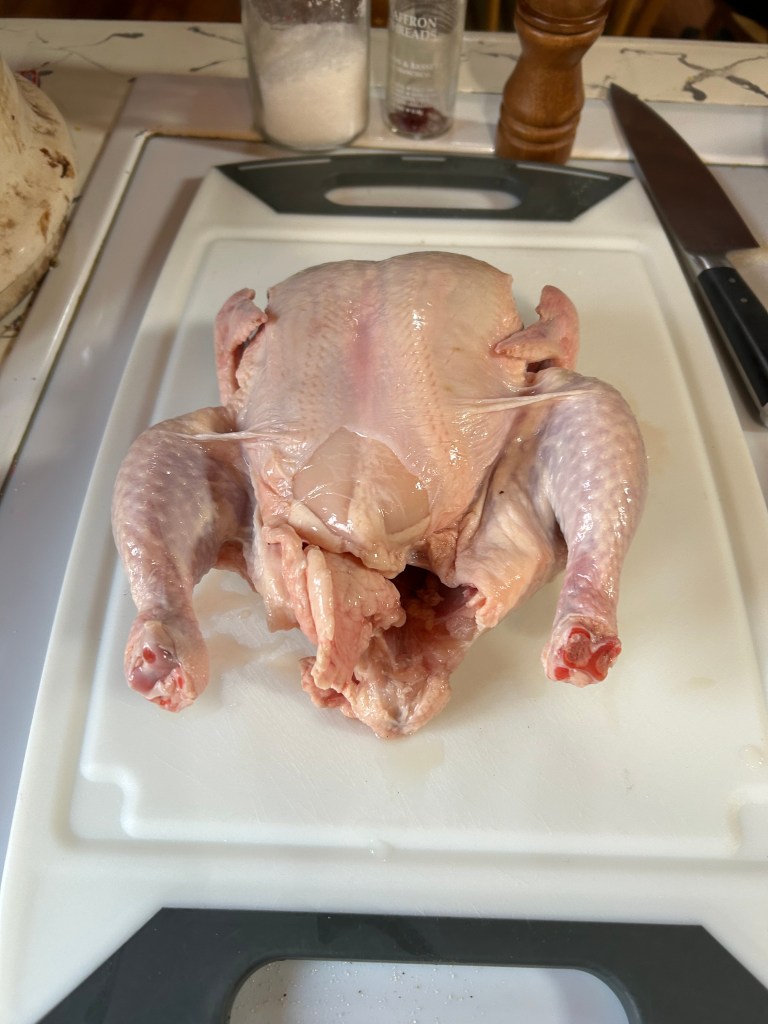
    First Step, cut up your whole chicken. I was able to divide the breasts in half, given their size

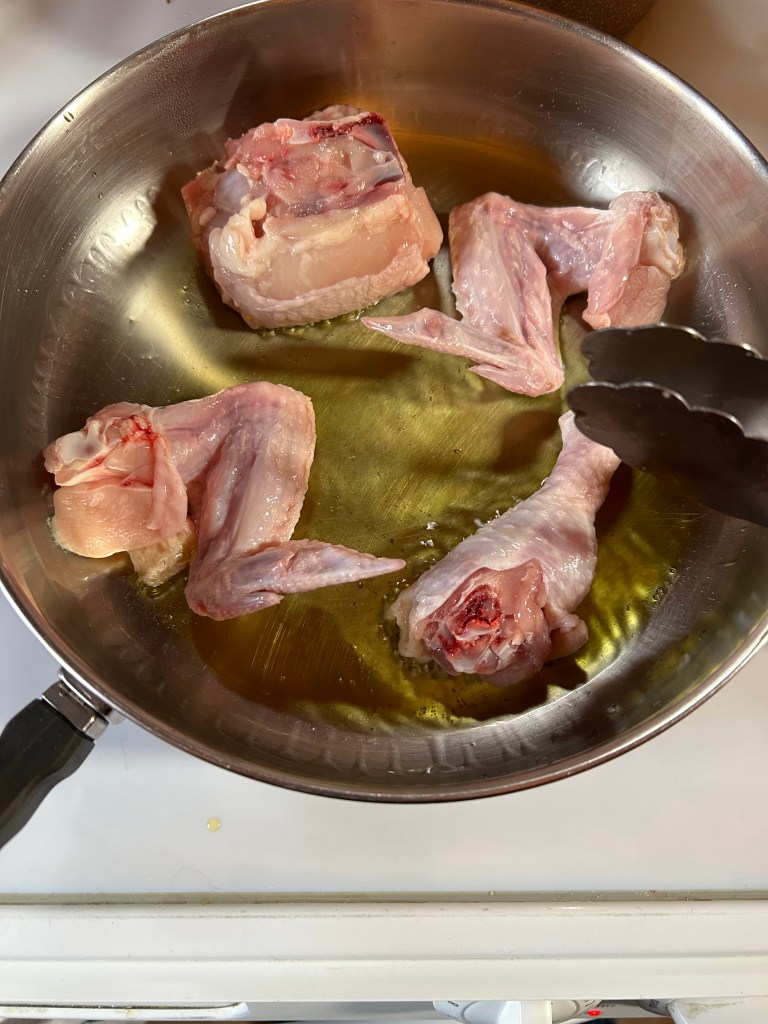
    As I do not have an enamel dutch oven yet (it’s on the to do list) I fried mine in my trusty 1970’s pan, making sure not to crowd it.

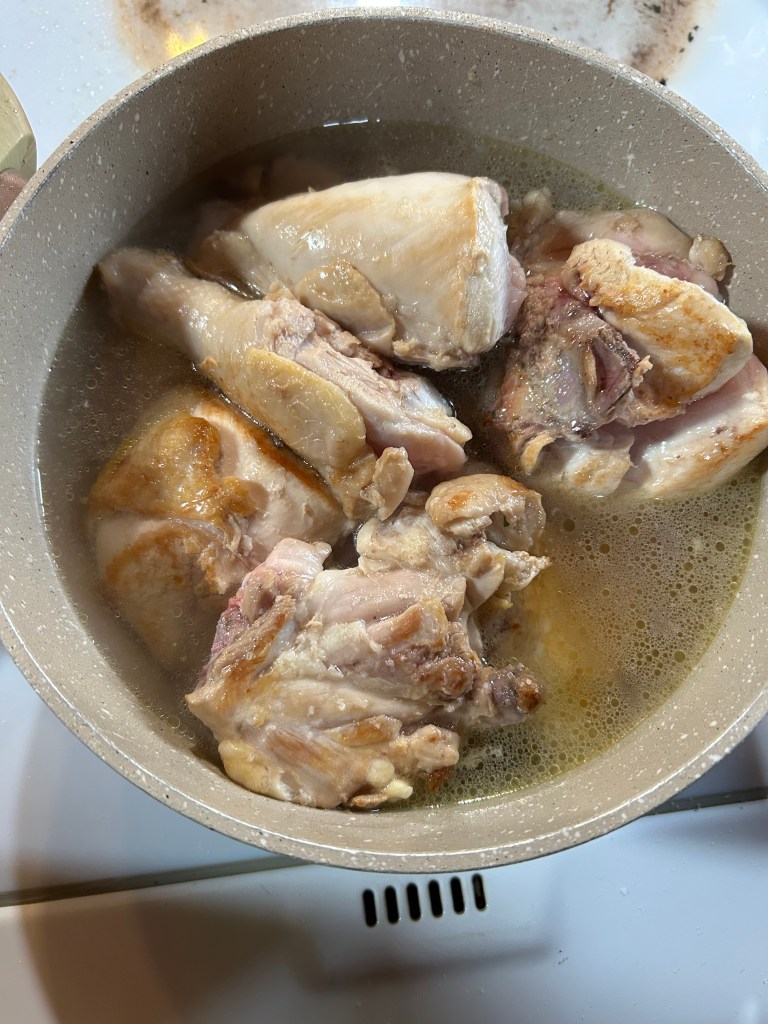
    And then transferred it to a pot to simmer.

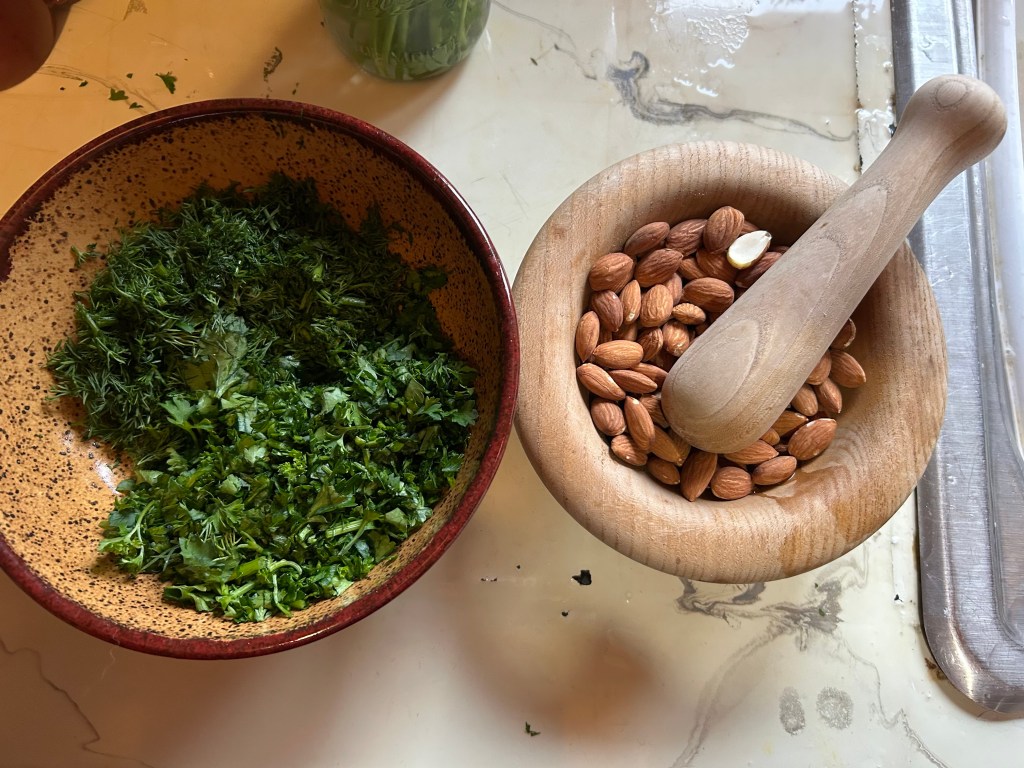
    Then measured out the almonds, dill and parsley to give them a blitz.

    I do not have a blender currently; getting a Vitamix has been on the list for a number of years now, but as a new homeowner, I have had other priorities that I’ve been taking care of first (like a generator, cause Maine. And taking my pets to the vet for dental surgery). And, they did not have blenders in the Medieval period. What they did have were a number of large and heavy mortar and pestles, as well as knives and cutting boards. I, however, chose to use my immersion blender and a bowl. I ended up having to add water in order to make it blend, and I think the next time I would use a food processor instead.

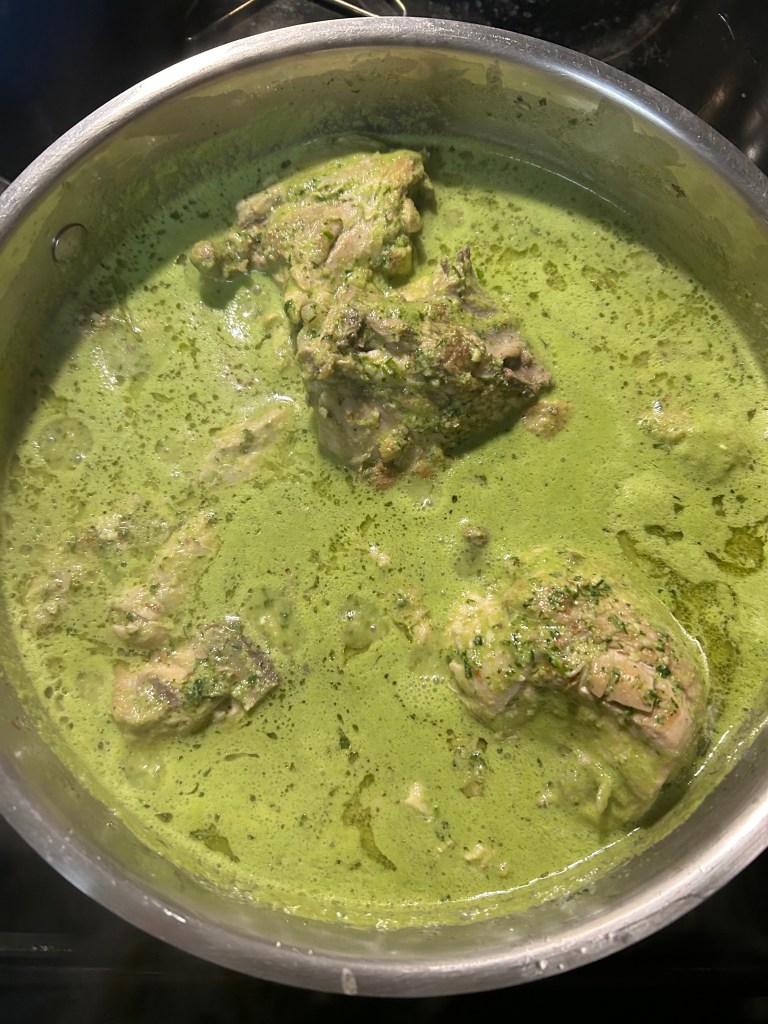
    The final product:

    It is a lovely shade of green. A couple of things I would do differently next time:

    • Now that I’ve made it, I’d swap out pine nuts, walnuts or pistachios for the almonds. The pine nuts might be prohibitively expensive due to the quantity needed
    • I think a smoother sauce could be created by removing the chicken from the pot, adding the puree to that, letting that simmer and then giving it another wiz with the immersion blender.

    I would totally make this again; it was tasty and I have left overs in the fridge for at least two more meals this week.

    A word on meat- most chefs/cooks will tell you to buy the best meat, in this case chicken, that you can afford. I’d like you to keep a couple of things in mind when working on a period recipe

    • Modern chickens that are found in grocery stores, unless you are purchasing a free range chicken, are much larger and much more tender than period chickens. If you are lucky enough to either have your own hertigage breed chickens or know someone who does, they are typically going to be smaller and tougher. Chickens that get lots of outdoor time and exercise are more well muscled, but also tend to be chewier and more flavorful
    • With the exception of the rich, and even then I’m not 100% sure and need to do more research, animals that produced things like wool, milk, and eggs were kept alive until they were no longer productive and were then slaughtered for their meat.( Pigs being the exception to this rule). A farmer making a dish like this around 12th night or any of the other celebratory days would have been using an old egg laying hen, and those things are not tender at all, and require additional stewing time.

    Additional information:

    Province of Malagentia. :https://malagentia.eastkingdom.org/main/

    Forest Court of Malagentia: https://malagentia.eastkingdom.org/main/foresters-guild/

    Malagentian Cook’s Guild : https://malagentia.eastkingdom.org/main/cooking/

    (Please note that both the Forest Court and Cook’s Guild pages will be under construction shortly)

    Heritage Animal Breeds: https://livestockconservancy.org/heritage-breeds/

    Project’s Spotify Playlist https://open.spotify.com/playlist/37i9dQZF1E38dccXtuZv1N?si=6d3d36249aea46d9

    Source Book: The Medieval Kitchen- Recipes from France and Italy by Odile Redon, Francoise Sabban and Silvano Serventi. Translated by Edward Schneider. Published by The University of Chicago Press, 1998

  • Making Mischief

    Welcome to my blog! My name is Meara MacNeil (mundanely known as Erin) and thank you for joining me on this adventure.

    Meara MacNeil is a 16th century Scottish persona that I play in the SCA; she is based at the court of Henry VIII, during the reign of Henry and Katherine of Aragon . She is the wife of a missing (read presumed deceased) upper class merchant, and as a favor to the king was made a lady of waiting to Catherine. Originally from the Isle of Barra, she is an accomplished wise woman, embroiderer, spinner, weaver and knitter. As a proper house wife would; she has the running of her husband’s estates in his absence.

    My EK Wiki can be found here: https://wiki.eastkingdom.org/wiki/Meara_MacNeil